Advertisement
CEPA
Hong KongHong Kong Economy

14 years after China free-trade deal saved Hong Kong from Sars slump, analysts warn city must innovate to make most of Cepa

Experts urge city to innovate as foreign investors enjoy more policy perks

3-MIN READ3-MIN
Chinese Vice-President Li Yuanchao (right) with Eddy Li Sau-hung, head of the Chinese Manufacturers’ Association, last month in Beijing. Photo: Simon Song
Nikki Sun

A free-trade deal with mainland authorities that was intended 14 years ago to bolster Hong Kong’s then-struggling economy may have run its course for the city unless it innovates, analysts warn.

June 29, 2003 was a joyful day for Hong Kong’s business community when China’s then premier Wen Jiabao came to town with an unprecedented agreement giving local investors preferential access to the massive mainland market – before extending the free-trade deal to other countries.
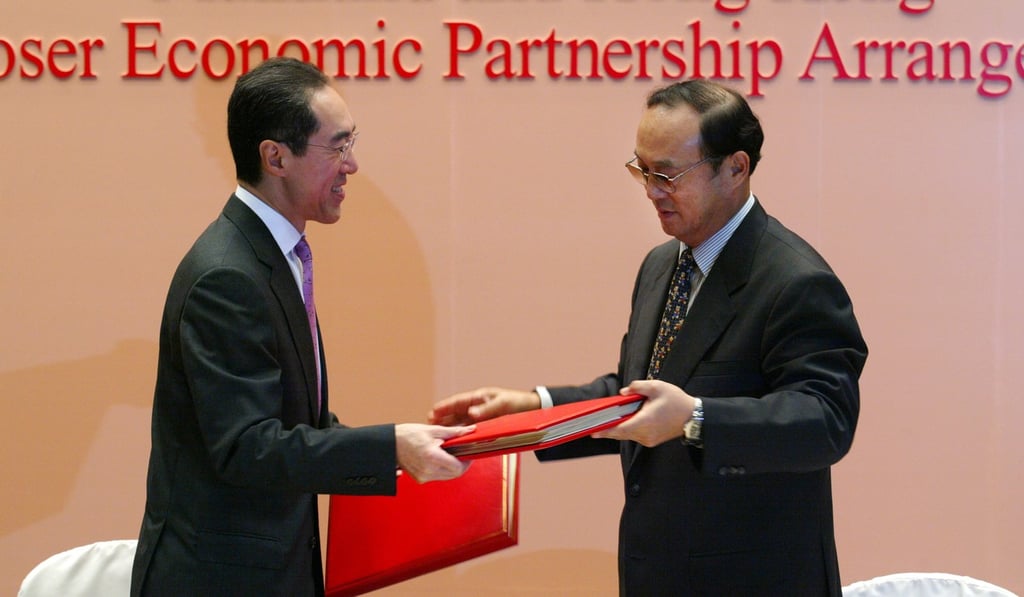
Then Hong Kong financial secretary Henry Tang Ying-yen (left) and then vice-minister of commerce An Min exchanging documents formalising Cepa in 2003. Photo: Martin Chan
Advertisement

The Closer Economic Partnership Arrangement (Cepa) was largely seen as a timely economic panacea offered by Beijing, as Hong Kong battled the devastating effects of severe acute respiratory syndrome, or Sars.

A month later, the launch of an individual traveller scheme threw open the city’s doors to mainland tourists, and the struggling local economy saw an immediate boost. Over the next decade, prosperity followed, and the scheme allowed more residents from key mainland cities to visit Hong Kong without needing to book tour groups.
Advertisement
Advertisement
Select Voice
Select Speed
1.00x