From Udaipur’s Jal Sanjhi to Jaipur’s City Palace – Rajasthan’s living art thrives
Discover Udaipur’s vanishing Jal Sanjhi water art and Jaipur’s royal craft revival – where heritage, tourism and artisan innovation breathe new life into Rajasthan’s cultural legacy

With powder-caked hands, Shri Rajesh Vaishnav gingerly lays a centuries-old paper stencil, passed down through generations, onto the canvas. In another motion, he rubs his finger back and forth into a spoonful of coloured dust held in a fine gauze pouch, pushing the light-blue pigment out. The pigment gently drifts onto the stencil, settling in a diaphanous layer.
Satisfied, Vaishnav lifts the stencil in a swift, decisive motion, revealing an image of the major deity Krishna as a flute-playing cowherd, poised against an Elysian scene of cattle grazing on lush, berry-laden bushes with peacocks and monkeys weaving in between. A breeze enters the room and the painting ripples ever so slightly, betraying the nature of the canvas underneath: not cotton fabric stretched over a wooden frame, but rather a square tub of holy water extracted from the River Ganges.
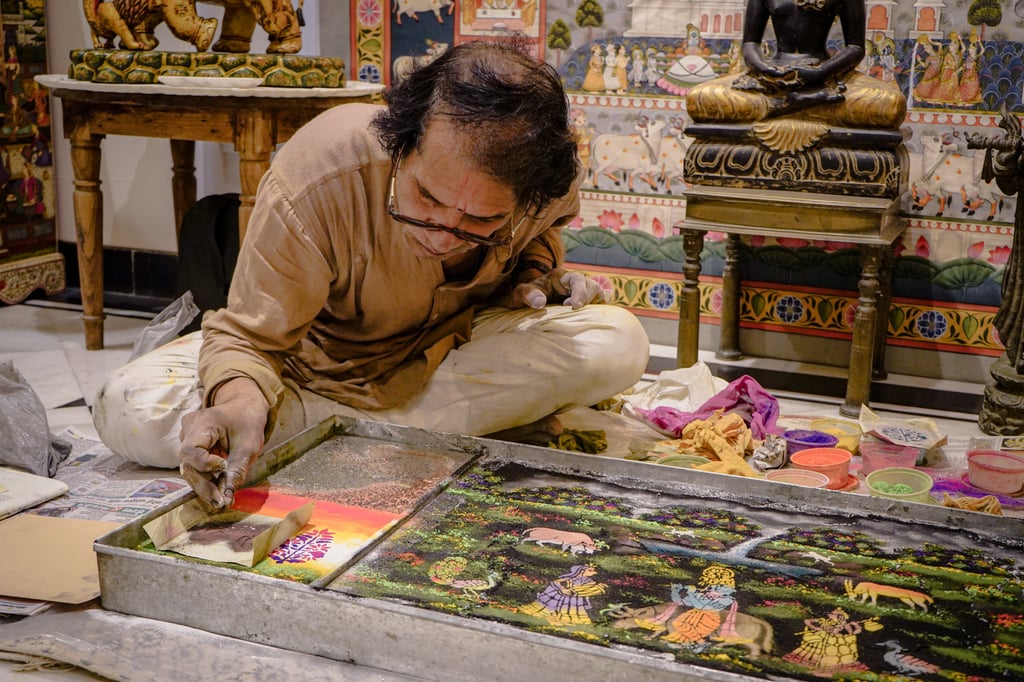
This is Jal Sanjhi, a religious art form specific to the historic city of Udaipur, in Rajasthan, India, that dates back 300 years and is practised by only two artists today, both of whom inherited the art form from their ancestors. Taking around an hour to create, each composition lasts at most for a day, before the pigments begin to sink into the water – a fitting metaphor for the beauty found in transience.
Standing over Vaishnav with his arms crossed is Hemendra Pujari, the founder of the Shyam Arts gallery that we find ourselves in. “There was a time when we Indians were looking for Van Gogh, then there were Van Goghs everywhere in the streets of India,” he says, scanning his eyes over the waterborne artwork and appreciating the fine details. “But when people went to visit the museums in London and realised that they were exhibiting the best of Indian art, it started making them feel proud of their own art. And they are bringing it back to their lives.”
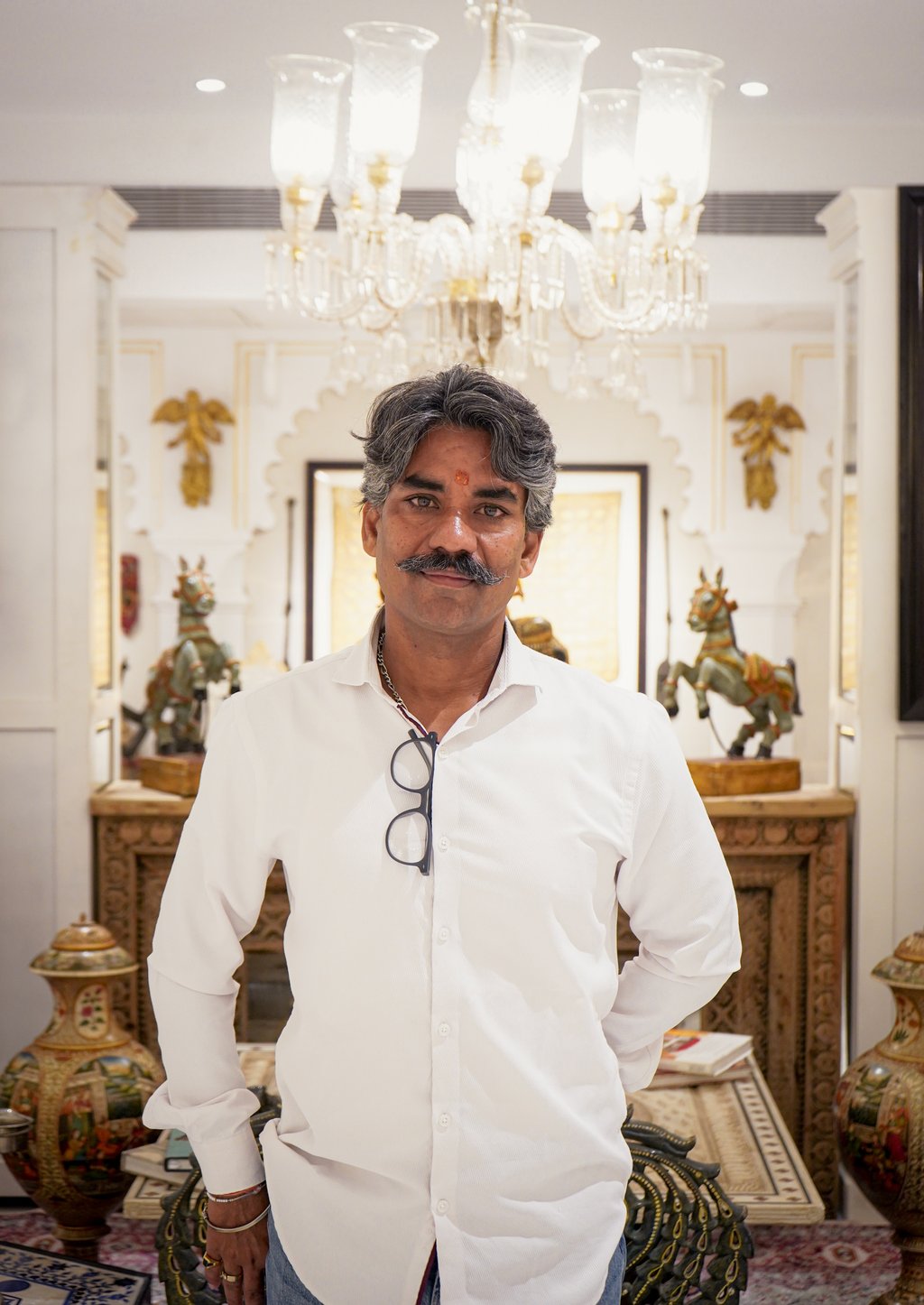
Pujari, whose glassy eyes and thick moustache give him the air of a reformed bohemian, is descended from a lineage of priests from the nearby temple of Jagdish Mandir. Having grown up with a deep appreciation for traditional and religious arts, the Udaipur native has made it his mission to educate the droves of foreign tourists from as far afield as the United States, Australia and Canada – more than 155,000 of whom arrived in 2024 alone – about the craft heritage of his hometown.
Tourism is what “gave a new hope of life to so many different things which would have disappeared”, says Pujari, gesturing at the classical artworks and antiquities hanging on the walls of his gallery. His life’s mission is to harness the power of tourism to breathe new life into Rajasthan’s disappearing arts, making them commercially viable and culturally relevant again.