Advertisement
China-Asean relations
This Week in AsiaOpinion

Asian AngleChina offers Southeast Asia clear nuclear power advantages

With its experience in exporting nuclear reactors, China can offer long-term energy security and technological upgrades

4-MIN READ4-MIN
Listen
Researchers inspect an alloy material sample used to build a Thorium Molten Salt Reactor at a laboratory of the Chinese Academy of Sciences’ Shanghai Institute of Applied Physics in October last year. Photo: EPA
Zha Daojiong
Southeast Asia stands at the threshold of a nuclear renaissance. Vietnam and Russia signed an agreement in March for the Ninh Thuan 1 Nuclear Power Plant. The Philippines and Indonesia aim to have operational reactors by the early 2030s. Malaysia, Thailand and Singapore are studying small modular reactors.

Given heightened energy insecurity, climate commitments and the imperative to meet surging electricity demand from industrial growth, data centres and AI development, nuclear energy is featuring more saliently in Southeast Asian economies’ development strategies.

Against this backdrop, China stands as an attractive partner alongside established exporters such as France, Russia, South Korea and the United States.
Advertisement

China’s nuclear export strategy is anchored in domestic industrial capacity built over six decades. With 61 operational reactors and 36 under construction as of 2026, China operates the world’s third-largest nuclear reactor network and is leading in new reactor construction. This experience has yielded technological self-sufficiency: China now designs, manufactures and constructs reactors domestically with primarily indigenous intellectual property rights.
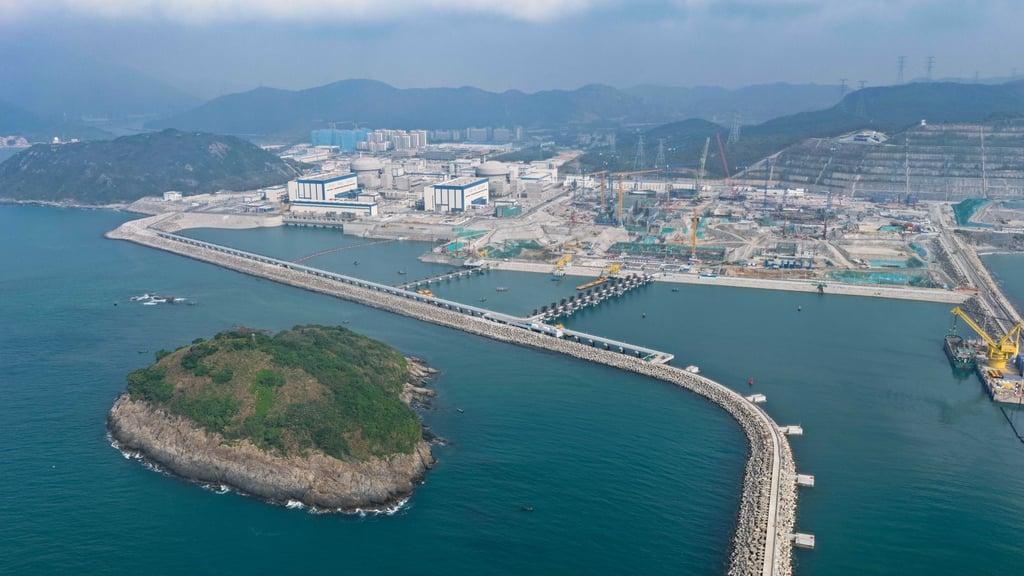
An aerial drone photo shows a view of China General Nuclear Power Group’s Taipingling nuclear power project in Huizhou, Guangdong province, last month. Photo: Xinhua
The flagship of China’s export push is the Hualong One, a third-generation pressurised water reactor developed by China National Nuclear Corporation and China General Nuclear Power Group (CGN). With 41 units operational or under construction, it is one of the world’s most widely deployed reactor designs. It features advanced active and passive safety systems, can operate for 72 hours without external power, and generates 1,090-1,100 megawatts per unit, which can meet the electricity needs of up to 1 million homes.
Advertisement
Advertisement
Select Voice
Select Speed
1.00x